Well Rounded Birth Prep

Well Rounded Birth Prep
WellRoundedBirthPrep.com

Search This Blog

Saturday, October 15, 2011

Pregnancy and Infant Loss Remembrance Day, whether I wanted to or not.

October 15th rolled around again: Pregnancy and Infant Loss Remembrance Day. I haven't mourned my loss of Evan Michael in so long I can't remember. (If you want to read the backstory, here's my post on The Day My World Came Crashing Down.) There are lots of reasons, I guess, but primarily because I've been too busy with responsibilities, deadlines, and other emotionally demanding issues that I haven't devoted any time to grief. I think I mistakenly tried to convince myself that I'm "making progress" or "moving forward" or some such baloney, since I haven't cried about it in so long and I can almost always talk about what happened calmly and with a level voice, as if I were recounting something that happened to somebody else, or maybe something I read about. On the anniversary of my loss this past April, and on the anniversary of burying Evan's remains in May, I didn't even get out my memory box or photo album.

It might have been October 15th last year when I last cried about Evan. I didn't pay much attention to October 15th coming up today. I didn't make special plans to memorialize his short life, light a candle during the Wave of Light around the world, or even post anything in particular about it on my Facebook. In fact, I rather wanted to avoid the subject altogether because I felt that if I ignored it, I'd be able to go along with my weekend as I have any other weekend.

Today snuck up on me and overtook me. Part of the difficulty of October 15th, for me, is that it coincides with Evan's due date/week, October 21, 2007. I feel on edge and melancholy from October 15 through 21, most years. Maybe I'm hormonal, at just-now 30 weeks pregnant. Maybe I needed a release valve for a number of other (unrelated) stresses. Or maybe I'm *still* ignoring the obvious: it was time to remember Evan, whether I was ready to or not.

I cried on and off all day. I managed to busy myself doing laundry, re-organizing the laundry room, culling outgrown kids' clothes, changing out seasonal clothes and new sizes for some of the kids, and using my label maker to get my laundry room and kids' dressers better organized (on the off chance that we could have people helping us with laundry after the baby comes). Anything that involves using my label maker substantially brightens my day. Additionally, Rick took me and our two older girls (ages 9 and 7; the 2 youngers are at their aunt's house tonight) to a Japanese Hibachi for dinner, which is a great show and an amazing meal. It was the girls' first time at a Hibachi, and they thoroughly enjoyed it. I felt much better once I got out of the house. I was too afraid to leave the house earlier in the day because I was afraid I'd have a blubbering meltdown, completely unprovoked, in the middle of the grocery store, at 7.5 months pregnant (but looking full term). I couldn't risk it.

Today, it felt like my emotional dam burst. I wanted to get it over with and move on with my day, but it kept resurfacing. I couldn't control or contain it. I just had to ride the waves.

I'd like to say, "Tomorrow will be better. Tomorrow is a new day," but I know that I won't truly feel the shroud removed from me until October 21 has passed, which would/could/should have been Evan's 4th birthday.

I guess I'm not immune to grief. Few are, and the odds were against me. It's part of the process, so I may as well embrace it, rather than feel like a failure for crumbling, for revealing vulnerability.

Wednesday, October 12, 2011

Midwifery = witchcraft???

One of my midwife friends, Laura Matthews, shared an experience with me recently that left me aghast. She gave me permission to post her story here.

Let me set up the backstory. Laura is a CNM with 12 years of clinical experience. She has supported births in both hospital and in birth center settings. She got her undergraduate degree at Bates College, her nursing degree at Fairview Hospital School of Nursing, and her Master of Science in Nursing/Midwifery at Case Western Reserve University. She has nearly completed her Masters in Biotechnology at West Virginia State University. She is researching her options to see which medical school will be the best fit for her as she pursues her goal of becoming an obstetrician. I'm thrilled that such a capable, qualified, holistic-minded midwife will serve in that capacity, and I'm really hoping she'll stay in our geographic area after she graduates from medical school. What an asset and a resource she is, and will be.

All this to say, Laura is a very educated midwife who has worked extensively to help and support mothers "within the system."

Laura was speaking with a recruiter of a prestigious medical school, who was set up at a table in the front hall of the science building to recruit medical school students and talk to them about the school and the admissions process. There were numerous current and potential medical students around the table. The recruiter introduced Laura to the group of students as, I kid you not, "Laura Matthews, who has 12 years of clinical experience as a witch." A worse Freudian slip has never been spoken. The crowd fell silent. Many of them turned bright red in embarrassment for the recruiter who so horrifically misspoke. Some of the students even tried to rescue the recruiter with jokes. The recruiter then stammered and tried to backpedal and salvage his introduction with a series of, "What I mean is..."

I realize that he didn't intend to call Laura a witch, nor did he deliberately attempt to publicly call midwifery "witchcraft," but that's the deep-seated-truth-telling essence of Freudian slips. Unless he had just concluded a prior, unrelated conversation with someone else about a witch costume for an upcoming Halloween party, it's my opinion that he must have accidentally revealed his true bias against midwifery and its legitimacy as a profession.

Midwives were the targets of persecution and literal witch hunts for several hundred years. Apparently, some modern-day medical school recruiters are *still* under the misimpression that midwifery = witchcraft. How sad.


Monday, August 29, 2011

Wide variety of healthy and normal in pregnancy

I predicted a few weeks ago that by the time I would be 6-7 months along, I'd get comments from strangers wondering whether I'd have the baby any day now. Yes, I carry obviously, with each of my pregnancies, pretty much from the time I get a positive pregnancy test. No exaggeration, I actually had to unbutton my jeans when I was sitting down, for several days before I got my positive pregnancy test this time around (and I had no idea I was pregnant), and have been wearing maternity clothes since about 8 weeks along.

There's such a wide range of normal! I wish more mothers--and America in general--understood and accepted this. People seem to have a very narrow idea of what is normal, but people come in all shapes, heights, builds, weights, and more--why wouldn't there be such a wide variation in healthy pregnancies as well?

So long as both mom and baby are faring well, there's nothing wrong with a mom carrying so "small" that she's barely showing, nor anything wrong with a momma who gets asked if she's having twins every time she leaves the house (even if she's carrying a singleton). Let's don't undermine another mother's confidence by questioning whether her size/appearance is too big or too little (unless you happen to be her care provider).

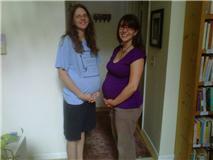
Take my friend Christy and me, for example. In this pic from this weekend, Christy is nearly 37 weeks along with her 4th baby (that is to say, she could go into labor any time between now and a month from now), and I'm 23 weeks along with my 5th. We're both healthy and fine.


My friend Trebor is due with her 5th baby around 2 weeks after I'm due. Just wait until later in our pregnancies and the difference will be photo-worthy, I promise.

Sarah 22 weeks, Trebor 20 weeks


In summary, here is a list of things nobody should ever say to a pregnant woman:

If you think mom looks "too big":
  • "Wow, you're huge!" (Does this sound like it could EVER be a good idea to say to a woman?)
  • "You look like you're ready to pop!"
  • "Are you sure there's only one in there?/Are you sure it's not twins/triplets?"
  • "I hope you don't go into labor right here and now!"
  • "Are you sure you're not due for 2 more months?" along with
  • "There's no way you're going to make it to your due date, since you're so big now." (The mom might go early, on due date, or 2 weeks late. How she carries/looks is not a predictor or indicator of how long baby needs to gestate. You'll either have her worried that she'll end up with a premie or disappointed if she gets her hopes up that she won't go all the way to her due date but then goes "late.")
  • "You had better not eat/drink that!" (This is sometimes said to a mom with a dessert or coffee in her hand. The observer has no idea what the rest of her diet looks like, not that it's any of their business.) 
  • "Your baby is going to be HUGE!!!" (Even if the mom has successfully and healthfully delivered 10 and 11 pounders already, this is NOT what a mom wants to hear. It's not encouraging.)
  • "How much weight have you gained?" (This is NEVER a good idea to ask a woman, unless you are her care provider.)
If you think mom looks "too small":
  • "You're so tiny you don't even look pregnant!" (This one can be especially upsetting for a mother who has lost one or more babies in the past, who might be concerned whether this baby will grow to full term healthfully.)
  • "Are you sure you're due that soon?" (No mom wants for people to imply that she needs several additional weeks/months to gestate, beyond the biological norm.)
  • "You'll probably have a teeny tiny baby." (No mom wants for anyone to imply that she'll probably end up with a premie or sick baby.)
  • "You should eat more." (No mom wants for random strangers to judge her diet. She might be eating the most healthful diet possible, and this is just the shape her body takes. Or she might be eating only junk. Either way, it's nobody's business but hers and her care provider's.)
  • "How much weight have you gained?" (See above.)
Here are a few starters for acceptable things to say to a random pregnant woman:
  • "You look great!"
  • "How do you feel?"
  • "Congratulations!"

Mommas, are/did you carry "large", "small," or in between? Did you receive any comments from people who thought you were carrying "too large" or "too small"? What affect did that have, if any? What positive things did people say about your pregnant appearance that encouraged you (or what do you wish had been said)?


**** UPDATE****

October 11, 2011

Remember how I told you that belly comparisons with my friend Trebor would be interesting over time? She's due two weeks behind me, with her 5th pregnancy this far along as well. She and our friend Eileen (3rd baby) share the same due date, and we three all have the same midwife. (This should be an interesting competition for who gets our midwife, and when. We're hoping we don't go into labor at the same time!)

L-R: me (Sarah) at 29 weeks; Trebor and Eileen at 27 weeks

************** UPDATE  Nov. 6, 2011 *************

Sarah at 33 weeks, Trebor at 31 weeks

Sarah at 33 weeks, Trebor at 31 weeks.

Can I say "I told you so" yet?

************ UPDATE December 1, 2011 *************

Same 3 mommies, same 3 bellies, a bit closer to due dates.

I'm on the far left. I'm 36.5 weeks along. Trebor and Eileen are both 34 weeks along. Yes, I'm aware that my belly is roughly 1.5 times the size of Eileen's and twice the size of Trebor's. You may also notice that Trebor and Eileen are a good 4 inches taller than me (I was wearing wedge heels; Trebor and Eileen were in flats).  When you're as short as I am, with a short torso, there's nowhere for baby to go but *out*.


Monday, August 22, 2011

Belly photo at 22 weeks


22 weeks along with our little boy and feeling pretty good. Yay for the middle trimester!

Tuesday, August 9, 2011

The Back-up Plan? Not so much.

I've heard so much about the homebirth spoof scene in The Backup Plan that I had to get it on Netflix DVD to see for myself. I knew it would be bad, and I was prepared for the fact that if homebirth appears in mainstream movies, it is almost universally made fun of. What I *wasn't* prepared for was the main character's sister's anti-child, anti-birth, anti-breastfeeding agenda.

In the first few minutes of the movie, J Lo's character explains how badly she wants a baby, but doesn't have her sister's support. Her sister has 4 kids and tries to talk J Lo out of having children. She says they "ruined her life" and destroyed her vagina (if that were true, she had very difficult, atypical births; this is not the physiological norm). She actually said "I hate them" (referring to her children)--within earshot of them. Wow, nice.

A few minutes later, she tells J Lo that breastfeeding will ruin her breasts and turn them into drooping "tubes" (total myth--it's PREGNANCY that can potentially affect perkiness/sagginess, NOT breastfeeding), and that childbirth will destroy her bladder (again, not the biological norm).

I'm sure the homebirth scene later in the movie would have been a hoot, but I didn't have the patience for it. I gave up after I had heard more than enough myths perpetuated for one night, let alone the horrible attitude the sister had toward children. I know it's just a "comedy," but I don't think it's funny. Someone is bound to believe those things when they hear them perpetuated in the mainstream. Not many people are likely to look it up for themselves to see what's true.

Wednesday, August 3, 2011

Cord blood banking vs. delayed cord clamping

A reader wrote in, "Sarah, What can you tell me about cord blood donation, I have heard so many different things on the contribution and I just want correct information to make an informed decision. Thanks for any information you can share."


I'll put together a link roundup so that each family can decide what's best for their situation.


Before we look at cord blood donation or banking as an option, let's first consider the importance for baby to receive his/her own cord blood immediately after the birth. There are options for collecting cord blood for donating or banking that *are* compatible with delayed cord clamping. 


If you haven't yet seen Academic OB/GYN Dr. Fogelson's Grand Rounds on Delayed Cord Clamping, it's well worth the 50 minutes to watch. He touches upon volumes of data supporting the importance of delayed cord clamping, including the effects of premature cord clamping that is common in the US, namely baby losing approximately 40% of his or her blood volume and the oxygenation from that blood. Baby also receives that rich store of his or her own stem cells, which is sometimes called "Nature's first stem cell transplant."  


The World Health Organization supports delayed cord clamping as well. Specifically, WHO states, "The optimal time to clamp the umbilical cord for all infants regardless of gestational age or fetal weight is when the circulation in the cord has ceased, and the cord is flat and pulseless, approximately 3 minutes or more after birth." 


The World Health Organization continues with these reasons for the recommendations:
  • "For the first minutes after birth, there is still circulation from the placenta to the infant, the majority of which occurs within 3 minutes, generally coinciding with the end of cord pulsations.
  • "Clamping the umbilical cord immediately (within the first 10 to 15 seconds after delivery) prevents the newborn from receiving adequate blood volume and consequently sufficient iron stores. Immediate cord clamping has been shown to increase the incidence of iron deficiency and anemia during the first half of infancy, with lower birth weight infants and infants born to iron deficient mothers being at particular risk. Up to 50% of infants in developing countries become anemic by 1 year of life, a condition which can negatively and perhaps irreversibly affect mental and motor development. According to one longitudinal study, Costa Rican children with chronic iron deficiency in infancy had 10 to 25 point lower cognitive test scores at 19 years of age, when compared to similar children with adequate iron status. Waiting to clamp the umbilical cord allows a physiological transfer of placental blood to the infant which provides sufficient iron reserves for the first 6 to 8 months of life, preventing or delaying the development of iron deficiency until other interventions—such as the use of iron-fortified foods—can be implemented.
  • "For premature and low birth weight infants, immediate cord clamping can also increase the risk of intraventricular hemorrhage, and late-onset sepsis. In addition, immediate cord clamping in these infants increases the need for blood transfusions for anemia and low blood pressure."
Australian midwife Rachel Reed's blog "The Placenta: essential resuscitation equipment" is well cited and helpful in understanding the crucial roles the placenta plays immediately after birth. She also explains how delayed cord clamping need not be at odds with neonatal resuscitation, should that become necessary. In many other countries, resuscitation equipment is on wheels and is brought close to the bed so that baby can continue to receive oxygenated blood while medical teams administer oxygen or other helps. 

Here's an article from the UK: "Trolley saves lives of newborn" with a description of a mobile bedside resuscitation unit that is currently used in 3 UK hospitals and may become standard in all UK hospitals. Here's a news clip that shows the Trolley and describes its use.

Here's an FAQ page on cord blood donation at marrow.org. Their page does not appear to address the need of each newborn to receive his or her own cord blood before considering donation for other purposes. It does state "No blood is taken from your baby, only from the cord and placenta after the baby is born," but this is only true if delayed cord clamping is done first. Otherwise, up to 40% of baby's entire blood volume IS taken from baby, only a small amount of which is donated for useful purposes, and the rest of which is disposed of as medical waste.


It's easy to find materials promoting the potential benefits of cord blood banking (many of which are industry advertisements for private banking). I don't currently have any bookmarked links on any solid independent research weighing the pros and cons of private cord blood banking. I do, however, have this article from an Irish newspaper titled "Stem cell storage can put lives 'at risk''. An excerpt: "‘‘In the vast majority of cases, the costs of storage are therefore not justified and the rationale being used by commercial companies recommending storage is misleading," said Sullivan. Sullivan said there was insufficient evidence to recommend its practice in Ireland except for a small number of at-risk families with rare blood diseases, malignancies or bone marrow failure... Collection of cells usually happens within minutes of a baby being delivered, ‘‘where there is a risk of post-partum haemorrhage and when both mother and baby require one to one care’’, Sullivan said.The harvesting of stem cells at this time led to added complications that might actually put the lives of mothers and babies at risk, he added."

For those who feel that cord blood banking or donation is right for them, Science and Sensibility posted an excellent article on the skill of some care providers to accommodate both delayed cord clamping AND cord blood collection after the birth of the placenta. This would mean that baby receives all of the blood that he or she needs, and that cord blood would be collected from the "excess" after the cord quits pulsating. It's not always possible as sometimes the cord blood has begun to coagulate by that time, but it's worth a try, if you would like to have the best of both worlds. Here it is for more info: "Journal of Perinatal Education 20.1 Feature Article: Umbilical Cord Blood: Information for Childbirth Educators."


See also my previous blog "Photo illustration: delayed cord clamping vs. immediate cord clamping"


As I collect more research on the subject, I'll add more links. I hope this helps as a springboard for more info.

UPDATE:

Nurturing Hearts Birth Services posted this fantastic series of time lapsed photos of an umbilical cord transitioning from full of blood immediately after birth, to thin, limp, and empty in fifteen minutes, after which time the cord was clamped and cut. If you are wondering how you will know whether the cord is ready to be cut, this is a great resource. Magic Umbilical Cords

Thursday, July 14, 2011

Guest post: A Journey Down Granola Blvd...

By Courtnie Thorsen

I have been asked more than once, about my reasons for being "crunchy",  when I used to be so "mainstream". Why now? What persuaded you? What made you change your mind?

The answer is alot of soul searching, alot of maturing, and alot of research.

I was 19 when I got pregnant with my oldest son. I sat in silence on the toilet watching the pee spread across that stick- the lump in my throat almost suffocating me as I seen the line turn pink. It didn't work out with the sperm donor and I, so I went at this thing called parenthood alone. I moved home- broke as hell, no job, and 6 weeks pregnant.

I had no plan, no idea what I was getting myself into, and no clue how to be a mom.

I put no effort into researching anything aside from breastfeeding. I was an excellent OB patient & went along with whatever I was told to do- or not to do.

My son was born 5 days before his due date. My labor was incredible. I spent the majority of it alone, at home in my bathroom. When my mom returned home from running errands, I was screaming upstairs...we arrived at the hospital at 9 centimeters. I was terrified at all the rushing around. Something must be wrong, this can't be a normal experience with all this panic going on.

I got the trusty epidural. No one bothered to tell me- it would all be over soon, that I had done and was doing an excellent job, that my body would not fail me now. Three hours later, after the threat of a cesarean section for not pushing him out fast enough- he was born. Covered in sticky meconium he was the tiniest, most innocent, most perfect creature my eyes had ever seen.

I sent him off to be circumcised. It is what all boys go thru. "How gross", I thought. 'Who would want to have such a disgusting penis?"

I took him home. His penis oozed this nasty pus and blood combination & try as I might- somehow the vaseline was always missing somewhere.

Breastfeeding was hard. He ate more than I could pump. We switched to formula at 11 weeks old. We got all of our shots on time, we made all of our well child visits. Soon my son developed severe constipation.

I met my Husband when my son was 7 months old. He loved us both, and we loved him. We got married in 2005 when Jack was 2. Jack started preschool and we were happy. When Jack was 4- his preschool teacher thought we should have him tested for ADD/ADHD. He was diagnosed a month later.

Around this time, my husband and I decided we wanted another baby. Jack's adoption by my husband had just gone thru & we were ready to expand our family. We conceived quickly and were ecstatic to learn our baby was a girl.

I knew I wanted to breastfeed. I feel the formula Jack was on, played an integral part in his bowel issues. I researched breastfeeding benefits. I also researched vaccines. What if having all those shots contributed to Autism, to ADHD, to other behavioral issues, his bowel issues?

My daughter was born 4 days before her due date. I was waiting for labor to begin & at my last doctor appointment- I begged to be induced. My daughter had turned and was laying on my sciatic nerve. I was so unbelievably tired of the strong "false labor" I had been having for weeks. Twice it needed to be stopped with medication in hospital.

My induction was routine. The labor was awful & my hopes for a drug free delivery were pushed futher into the hallway with each drip of the pitocin. I argued with our crappy nurse pretty much thru the whole thing. I was really pissed though, when I was told to "labor down" as my daughters head was about to crown. And let's not forget when I was told I was complete at 5 freakin' centimeters.

None the less, when they placed my pink, perfect Savannah on my belly- the rest of the world faded into the background. She was here and she was awesome!

Our breastfeeding relationship was strong. So strong it took us thru two bouts of mastitis, new teeth, and an attempt at ending our co- bedding arrangement.

We nursed everywhere. I began to see how important my breasts were to my daughter. How she couldn't wait to snuggle me and them when I got home from my part- time job, when she hurt herself, when she was tired, when she needed reassurance, when all was not right in her world. When she broke her arm- it was my breasts that comforted her in post op.

Our delayed vaccine arrangement was working too. She was healthy & at home with one of us, all the time.

Someone was missing in our family. I stayed up late at night thinking about it. It consumed my thoughts. I cried when I packed up clothes Savannah was growing out of.

We again conceived quickly. Only this time, I had done my soul searching. What was I trying to fix? What was I trying to prove?

I KNEW there was a better way. A more natural way. An instinctual way to parent. I hired a doula, and drove 40 minutes each way to a midwife. I wanted to birth my way. I didnt want to tear because I was pushing to slow & had better get it out or else. I didn't want to be told to stay in bed, or labor down or have a cathater stuck up my urethra. I didnt want to be told when to push, how to push or where to push. I didn't want someone to start an IV, to make me change into an ugly, scratchy hospital gown, or stick their fingers in my vagina every 2 hours to check if I was progressing on their time. I didn't want my son's genitals cut up without his consent. I didn't want him stuck with needles upon his entrance into the world. I didn't want crap in his eyes, spread so thick I couldn't see their depth. I didn't want anyone to clamp his cord to early, severing the rich blood that had nourished him for 10 months. I wanted to feel my son be born. I wanted our bodies to work in tandem to meet each other. I rode those powerful waves of perfection & it was divine.

Brody was born in a freestanding birth center on October 12, 2010. While his birth was not perfect, it was damn close. I was respected & so was my child.

For our family, there is a better way- a more natural way. An intended way of going about giving life & living life. I have made my mistakes along the way & still do. But I know now that no one but my husband and I have our families best interest at heart.

I will not be responsible for someone turning a profit over my families well being. I make it my job to be informed in regards to how I raise my children and the choices I make for them & the ones I allow them to make for themselves. Birth is normal, natural and incredible. Vaccines are a personal choice & should not be forced upon anyone. Circumcision is abuse, a violation of the child's human rights & should not be acceptable. Breastfeeding is bestfeeding, and good nutrition is key. Doctor's only know what they are taught & good or bad- all of them make a profit off of you. Babywearing is good for your baby & promotes the most basic of bonding principles that is trust. I will not leave you to cry it out for your needs are just as important as my own. Co-sleeping is amazing. You sleep- I sleep, we all sleep with co- sleep!

Follow your gut, and your heart. No book, or doctor, or article can tell you more than your instinct. If something isn't sitting right with you- speak up & speak out!

Courtnie and her children